
- Cloud
- Published on: 11.12.2025
Smart Future for E-Mobility: Audi, MHP and AWS Optimize the EV Charging Infrastructure Proxy Service
Electro-mobility is experiencing rapid growth. In 2022, 10.5 million electric vehicles were registered worldwide; by 2023, that number had increased to 14.5 million. Currently, approximately 20 percent of all passenger cars sold globally are electric. This growth is fueled by international climate goals, such as the EU’s aim to achieve climate neutrality by 2050. However, without accessible and reliable charging infrastructure, electric vehicles risk remaining a niche market. Drivers expect to be able to charge their vehicles as easily as they can refuel combustion engines, anytime and anywhere.
Services that plan routes with charging stations face major challenges. Unreliable data sources affect the accuracy of recommendations, and information on the availability, charging capacity, and operational status of charging stations is often missing. Drivers may arrive at charging stations that no longer exist, are temporarily out of service, or cannot deliver the required charging power. This makes optimal route planning impossible. In such cases, drivers may find themselves "in the middle of nowhere," unable to charge their vehicle — a frustrating scenario that undermines trust in electric mobility.
A key component of successful electric vehicle charging infrastructure is the Audi EV Charging Station Proxy Service. This service transforms complex raw data into driver-friendly information, such as station locations, connector types, and real-time availability. It is essential for providing drivers with accurate, relevant data to optimize the planning and use of charging infrastructure. To improve efficiency, Audi and MHP enhanced the EV Charging Station Proxy Service in collaboration with AWS.
Challenges of the Original Audi EV Charging Station Proxy Service
The original architecture of the Audi EV Charging Station Proxy Service was based on a Kubernetes cluster within AWS Elastic Kubernetes Service (EKS). While this EKS environment offered flexibility, managing the clusters and scaling the application required significant operational effort. The main challenges of the former EV Charging Station Proxy Service structure included:
- Complex management: Maintaining and scaling the clusters was resource-intensive and required specialized expertise.
- High operating costs: The overhead of cluster management put a strain on the budget.
- Scaling difficulties: Updates, upgrades and system expansions were slow and inefficient, making it difficult to respond quickly to new requirements.
- High maintenance workload: Due to the complexity of the service, including the infrastructure and code, maintenance was extensive.
- Lack of transparency: There was no clear overview of infrastructure costs or optimization potential.
These limitations meant that the infrastructure could not ideally meet the growing demands of electromobility and the expansion of electric vehicle charging infrastructure. Therefore, it was necessary to migrate the service to a more cost-efficient, scalable, and easier-to-manage environment.
The Solution: Migrating the EV Charging Station Proxy Service to AWS ECS
To address these challenges, Audi migrated the EV Charging Station Proxy Service from AWS EKS to AWS Elastic Container Service (ECS), leveraging Amazon Web Services' serverless computing solutions: AWS Fargate, AWS Lambda, AWS Step Functions, and AWS EventBridge. This modern, cloud-based architecture provides serverless container orchestration, significantly reducing the operational effort required to manage the infrastructure.
The migration included the following core aspects:
- Scalable architecture: ECS allows the infrastructure to adapt dynamically to vehicle communication requirements, greatly improving efficiency.
- Migration to the AWS Cloud: Moving the EV Charging Station Proxy Service to the AWS Cloud enables reliable, real-time data processing and integration of modern technologies. Therefore, recommendations can always be delivered accurately, up to date, and tailored to user needs.
- Use of AWS Fargate: The serverless architecture eliminates the need for manual cluster management, saving personnel and technical resources.
- Amazon Elastic Container Registry (ECR): Using Amazon ECR allowed for the seamless deployment of new software versions and significantly simplified the development cycle. The migration was completed within one month.
- Transparency and monitoring: A new dashboard was implemented to enable real-time monitoring and ensure full transparency of costs and system status.
Thanks to the EV Charging Station Proxy Service's existing containerized architecture, the migration was fast and executed without service interruptions. Within one month, the migration was complete, and the service was fully operational in the new environment. The existing fleet of electric vehicles smoothly migrated to the optimized service without technical adjustments, and data availability remained intact.
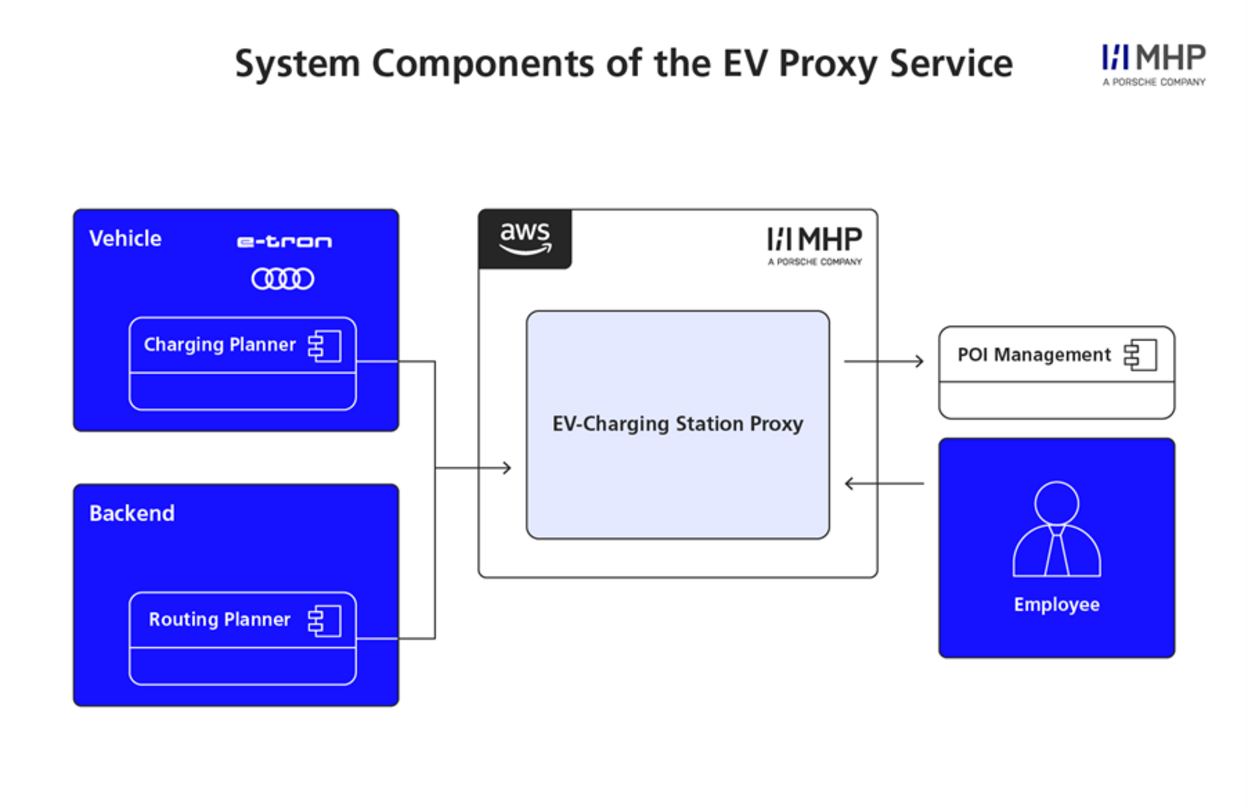
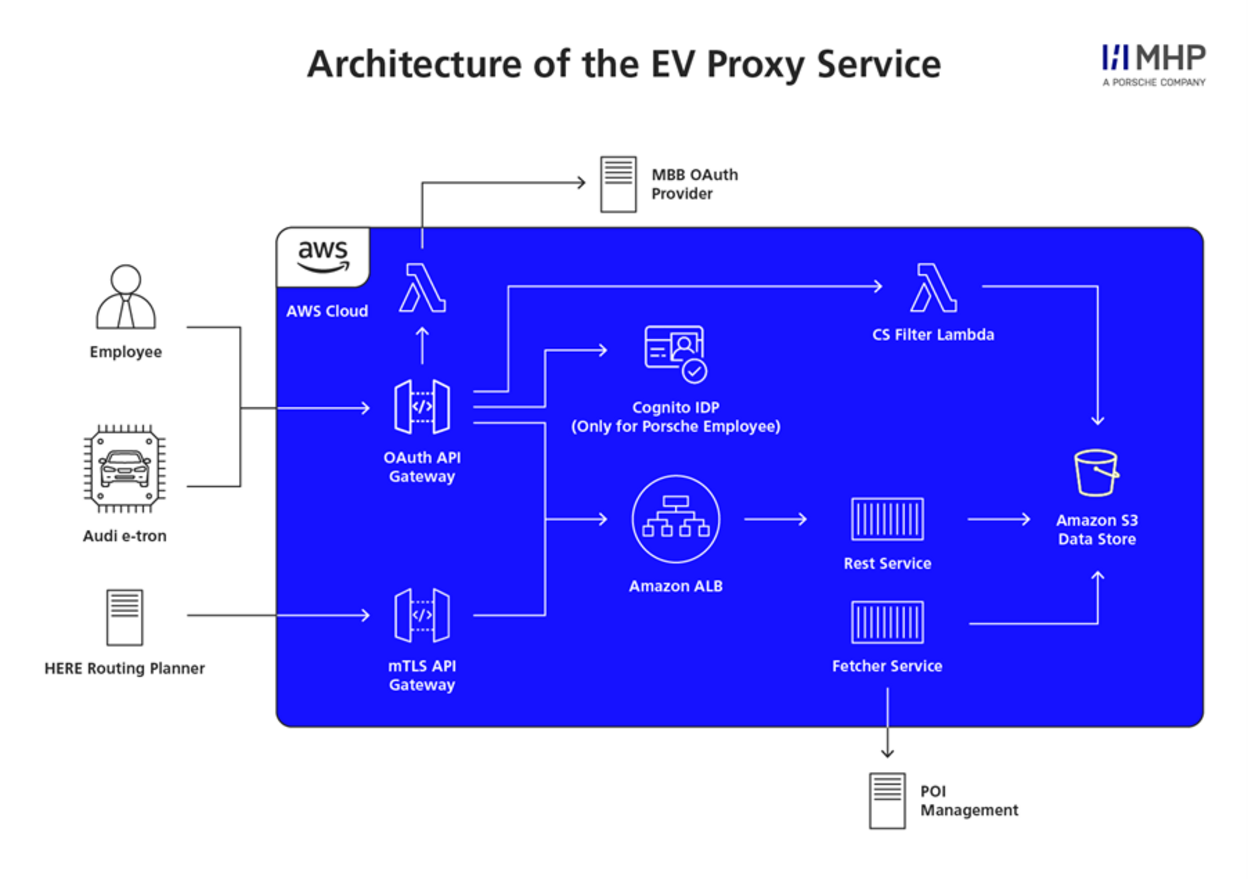
Real-Time Data and Automatic Scaling: How the New Cloud Solution Optimizes Charging Recommendations and Route Planning
The switch from AWS EKS to ECS using AWS Fargate significantly improved the operation of the Audi EV Charging Station Proxy Service:
- Cost reduction: Eliminating cluster management significantly lowered operating costs, and the use of serverless solutions minimized infrastructure resource consumption through a pay-as-you-go model.
- Scalability: ECS adapts in real time to the changing communication requirements of vehicles, continuously optimizing resource usage. Even during periods of high demand, the new EV Charging Station Proxy Service remains cost-efficient and scalable.
- Increased efficiency: The serverless infrastructure allows for better resource utilization and reduced operational effort.
- Enhanced security and compliance: Service and security policies align with group standards, and server-side governance, including certification authority management, is implemented.
- Faster software deployment: Using AWS ECR and an optimized pipeline accelerated the delivery of new features.
Improved transparency and operational reliability: A new dashboard now monitors the state of the infrastructure in real time. This increases transparency and provides automatic alerts at defined thresholds, ensuring high operational reliability.
How the Audi EV Charging Station Proxy Service Enhances the Charging Experience and Route Optimization
The EV Charging Station Proxy Service plays a central role in optimizing the charging experience for electric vehicle users. It processes raw data from different sources specifically for each vehicle. It provides precise and tailored information on charging locations, available plug types, and real-time availability. This allows drivers to access current and relevant information at all times. Consequently, route planning becomes more efficient, and disappointments caused by incorrect or incomplete data are avoided.
These optimizations strengthen confidence in electric mobility and make electric vehicles more practical and convenient for everyday use.
Outlook: Future-Proof Charging Infrastructure with Audi and AWS
The migration is a crucial first step in the continued development of reliable data delivery in electric mobility. Furthermore, the new architecture enables continuous, efficient advancement of the service through measures such as:
- Integration of ServiceNow: This will further optimize operational processes and enable more efficient management of operations.
- Real-time data analysis: This provides real-time information about the availability of charging stations and their charging options.
- Expanding end-to-end monitoring: Increasing transparency in the dynamic route planning product allows for precise analysis of the entire system, including vehicles, EV Charging Station Proxy Services, and POI providers.
These measures demonstrate our commitment to improving the user-friendliness and reliability of the electric vehicle charging infrastructure. With the migration of the EV Charging Station Proxy Service, a scalable, efficient platform has been established that meets current and future requirements.
AWS and MHP Make Electric Mobility Smarter and More Reliable
Migrating the Audi EV Charging Station Proxy Service from AWS EKS to ECS with Fargate demonstrates how to optimize existing cloud infrastructures to make operating software solutions more efficient and cost-effective. Through dynamic scalability, enhanced security measures, and a transparent monitoring system, the technical infrastructure was improved and a foundation was created for an enhanced user experience. This optimization ensures the reliable delivery of charging information for electric vehicles, meeting the growing demands of an increasingly digital and connected mobility landscape. It also demonstrates how technology and strategic planning can drive the mobility of the future.