- Impulse
- Published on: 27.04.2026
Small and Medium-Sized Enterprises: The Backbone of Defense Readiness
Why the Rules of Engagement in Defense Supply Chains are Being Rewritten
New Defense Logic, New Opportunities for SMEs
According to the Federal Association of the German Security and Defense Industry (BDSV), approximately 70 percent of all Bundeswehr contracts by volume go to small and medium-sized enterprises (SMEs). Yet SMEs, in particular, have limited visibility into how defense requirements take shape, which supply chains are currently taking shape, and what criteria drive partner selection. Conversely, end-users often struggle to identify and assess the full spectrum of industrial capabilities already embedded in the defense ecosystem. The underlying issue is a lack of transparency mechanisms in a system under growing procurement pressure and a steadily rising pool of market participants.
This mutual lack of transparency is a major barrier to the expansion of defense supply chains now underway. The driver behind that expansion: industrial supply and production structures must function under crisis and wartime conditions. Resilience is becoming the defining factor behind new partnerships.
Entering the defense ecosystem works differently from conventional market entry. Needs arise simultaneously and interactively at the strategic, operational, and logistical levels. Furthermore, they pass through multiple layers of interpretation before reaching industry as actionable specifications.
As defense supply chains evolve, the terms of participation are being redefined. Strategic visibility is becoming a decisive factor.
The central question: How does a company catch the attention of the actors who are building these structures right now?

SMEs As Key Players in New Industrial Networks
An Investment Boom is Fueling Growth and New Supply Chains
The security policy landscape is reshaping priorities and industrial structures alike. Investments are rising significantly, paving the way for new supply chains.

Figure: Defense spending on the rise, Germany and EU-27. A significant investment surge meets deep structural transformation Sources: Bundestag, BMVg, EDA Defence Data 2024–2025, EU Council
SMEs: The Critcial Backbone
SMEs already form a vital part of defense industry value creation. Their supplier base is critical to the scaling and delivery capacity of major defense manufacturers.

Networked Defense Capability Structures
The current study “Germany as a Logistics Hub” conducted by Quadriga University Berlin, BwConsulting, and MHP, examines civil-military cooperation under realistic operational scenarios.
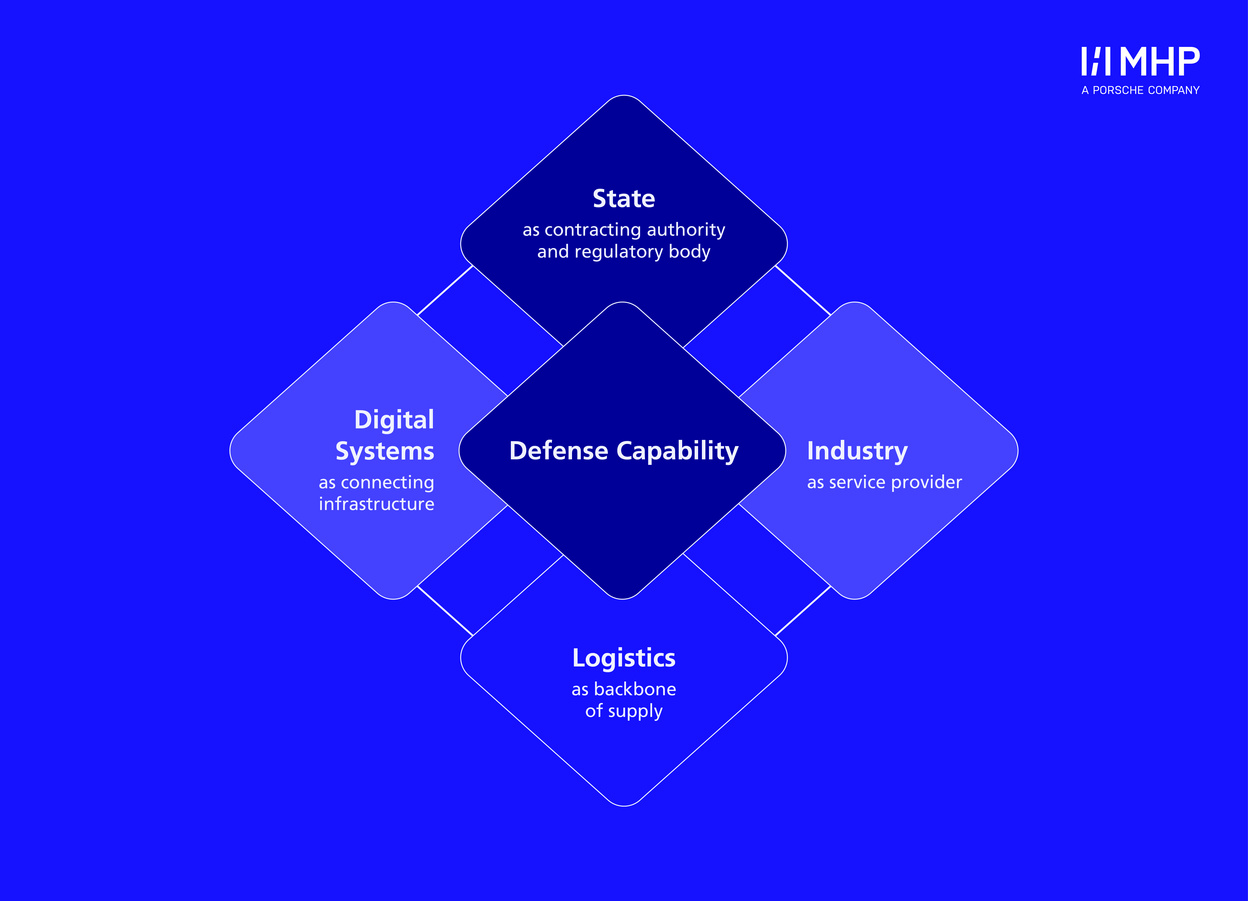
Defense capabilities rarely emerge in isolation. They are the product of integrated civil-military value chains, bringing together:
- Federal, state, and municipal bodies as clients and framework providers
- Industry as service providers
- Logistics as the backbone of supply
- Digital systems as the connecting infrastructure
In this setup, participation increasingly depends on connection.
The question every SME must answer: Where in the system are my capabilities visible - and where can they be integrated?
From Peacetime Efficiency to Crisis-Ready Resilience
The demands placed on supply chains shift fundamentally depending on the scenario. Understanding this logic is essential.
Peace:
- Efficiency and cost optimization
- Predictable demand and stable processes
Crisis:
- Rapid inventory expansion
- Compensation for deferred or delayed investment decisions
- Full transparency over available capacity
- Decentralized distribution chains
Defense:
- Maximum speed and scalability
- High resilience under sustained pressure
- Long-term operational endurance
- Effectiveness over efficiency
Conclusion: In peacetime, being a reliable supplier is often sufficient. In a crisis, a company must be able to act immediately.
Defense Readiness as an Opportunity for Industrial SMEs
Against this backdrop, the implications for industrial SMEs are significant and they require a fundamental shift in how companies think and operate:
- From performance to strategic positioning
- From individual orders to network access
- From reaction to prepared readiness

Figure: Participation in defense supply chains is typically shaped by three pillars
Clarity on Capabilities
- Clear classification of a company’s capabilities within the defense context
- Translating products into specific operational functions
- A compelling answer to the question: What is this company needed for in a crisis?
Structural Readiness
- Scalable production and processes
- Security of supply and operational robustness
- Regulatory compliance - procurement law, safety standards, certifications
- Responsiveness under time pressure
Ecosystem Connectivity
- Data protection and security-compliant visibility in relevant networks
- Secure interfaces and formats defined by end-users at all levels - a prerequisite for access to system integrators, platforms, and partners
- Active positioning within the broader ecosystem
Conclusion: Defense capability is no longer forged solely at the point of procurement. It is built during the industrial preparation phase, when requirements are defined and translated. For SMEs, this calls for an honest self-assessment, ranging from a status review to a willingness to evolve capabilities and expand networks.
Case Studies: Where New Defense Supply Chains Are Currently Emerging
SVI Connect:
The platform tackles precisely the challenge that has held so many SMEs back: invisible capabilities in a system with limited transparency. By making companies visible and enabling connections, SVI Connect shows how participation is being organized today.
- Approximately 1,400 registered companies
- More than 80 percent are SMEs (BME, SVI Connect platform)
- Goal: Making capabilities visible and building actionable networks
Rheinmetall Convoy Support Centers:
Rheinmetall has secured €260 million to establish Convoy Support Centers along military deployment routes (Source: Reuters).
- Framework agreements secure services before specific needs arise
- Readiness becomes a key qualification
- Availability matters more than delivery alone
Conclusion: Readiness As the New Industrial Guiding Principle
Both examples follow the same pattern: Relevance is established before demand materializes. This opens a strategic window for SMEs. And this window to shape structures and partnerships is now.
New Opportunities for SMEs: What Matters Now
- Visibility is increasingly determining participation
- Being seen within the system is becoming business-critical
- Capabilities must be known and assessable across the defense ecosystem
- Resilience is becoming a selection criterion
- Scalability, robustness, and the ability to perform under pressure are non-negotiable
- Availability now stands alongside efficiency as an equally important requirement
- Ecosystem access secures long-term relevance
- Connectivity must be established early
- A presence on platforms, in networks, and with system partners is essential
Chart Your Course into Defense Supply Chains
This Impulse draws on key findings from our study “Germany as a Logistics Hub.” It is essential reading for anyone looking to explore this topic in depth. If you’re interested, you can download the full study here.
Is this topic already relevant to you? Start by answering the following three questions:
- Are your capabilities visible and easy to assess within the defense ecosystem?
- Can your structures withstand a scenario beyond normal operations?
- Are you present in the networks where supply chains are being configured right now?
MHP supports SMEs in strategically positioning themselves within new defense supply chains. Let’s discuss this further. I look forward to hearing from you.