
- Newsroom
- Published on:
AI agents – “The CEO Won’t Be Replaced – But Their Impact Will Become Scalable”
Benjamin Brodbeck: Florian, everyone is talking about AI agents these days. But let’s be honest: isn’t this just ChatGPT with a new name?
Florian Langer: I hear that question a lot, and I understand it. But the difference is fundamental. A language model answers questions – and it does that exceptionally well. An agent gets work done. It understands a company’s context, accesses the right knowledge sources and systems, operates within clearly defined rules, and executes processes independently. A simple example: You can ask ChatGPT what a good decision memo looks like. An agent creates it – overnight, based on the latest figures, following your company’s logic and standards, and places it on your desk in the morning. That’s the leap from answering to acting. And that leap will fundamentally change how companies use knowledge and prepare decisions.
Benjamin Brodbeck: MHP – your team – recently developed a digital twin for an executive. What exactly does that mean?
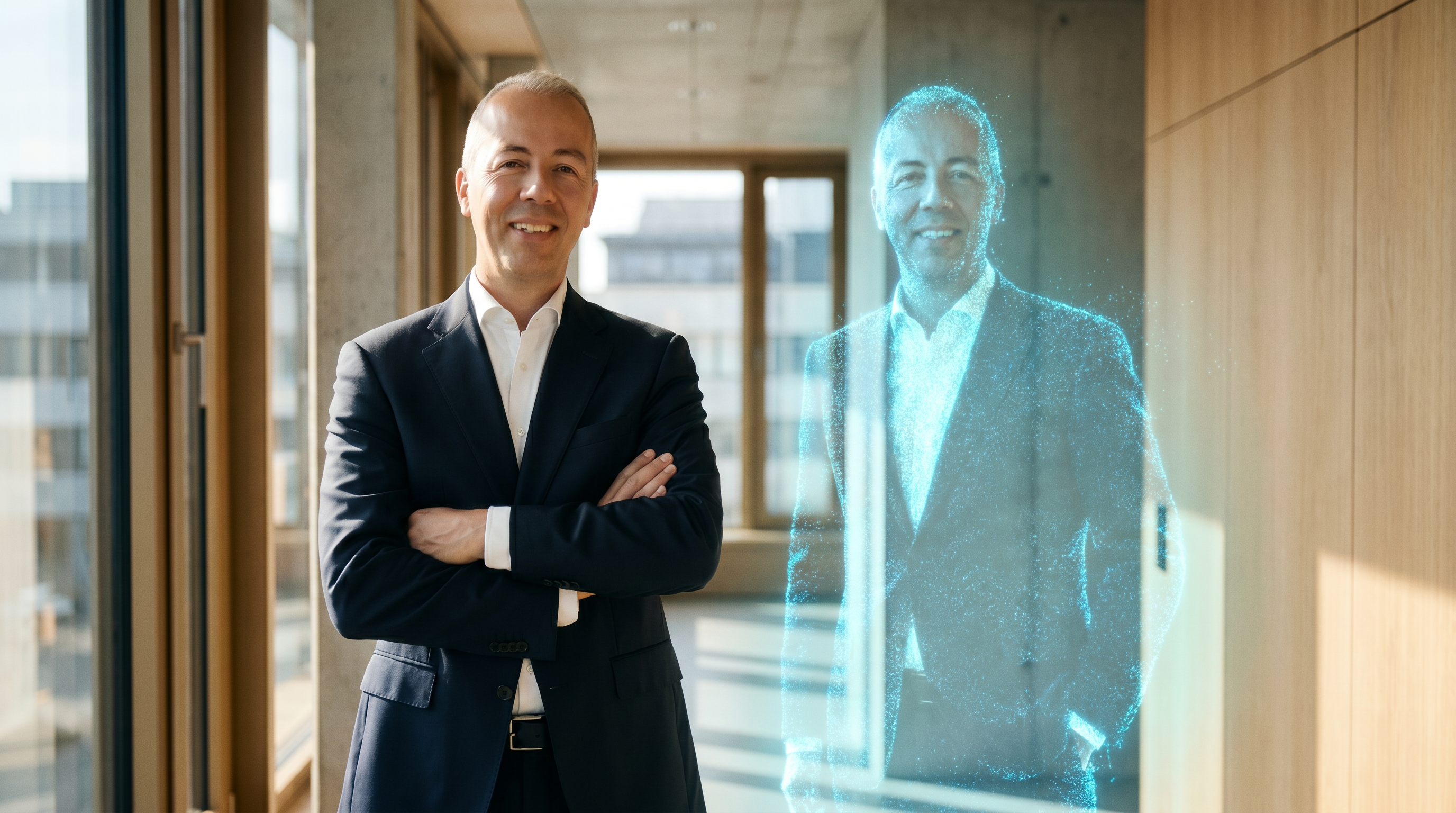
Florian Langer: First of all, let’s clarify what it is not: it’s not a chatbot with my name and a friendly avatar. A digital twin of an executive makes three things digitally available: expertise, decision-making logic, and communication patterns. The system learns how a person evaluates topics, sets priorities, and prepares decisions. This enables the twin to generate analyses, assess scenarios, and prepare communications – at any time and at a speed no calendar in the world can provide. Just as important to me is being honest about its limitations. A twin does not replicate a personality. It has no intuition, no experience accumulated over thirty years of professional life, no gut feeling in a critical negotiation. What it can do is make a large portion of existing knowledge and established ways of thinking accessible when I’m not in the room. That is a lot – but it is not everything. And we shouldn’t pretend otherwise.
Benjamin Brodbeck: Many would argue that executives and CEOs, of all people, should be irreplaceable. Doesn’t a digital twin contradict that idea?
Florian Langer: Quite the opposite – it reveals what leadership is really about. If the role of a leader were simply to process information and prepare documents, then yes, they would be replaceable. But leadership is not that. Leadership means providing direction, taking responsibility, and bringing people together – especially when situations are unclear. The real problem in many organizations is that valuable experience and expertise are locked inside individual people’s heads. When that person is on vacation, sitting in another meeting, or leaves the company, that knowledge becomes inaccessible. A twin addresses exactly this challenge. Teams gain faster access to informed perspectives, and decisions can be prepared more effectively without requiring constant involvement from the executive. The twin doesn’t replace the leader. It extends their reach. And, frankly, it gives them more time for the things only they can do.
Benjamin Brodbeck: Many people probably think of a digital twin as a software project: you build it once and then it runs. Yet we keep hearing that the real work starts afterwards. How much maintenance and development does a digital twin require – and where is the real value created?
Florian Langer: That may be the biggest misconception of all. A digital twin is not a product you build once and then put into operation. It works exactly like we do as humans: it has to keep learning continuously. And the crucial point is that this learning happens in both directions. I experience this with my own twin. There is an ongoing exchange between us. I give it tasks I want it to master – whether that’s exploring a new topic or creating a specific type of deliverable. But that alone isn’t enough. I need to understand its output. I need to see how it approaches a problem, where it gets things right, and where it misses the mark. Only then can I correct it, refine it, and teach it more about how I think. And the reverse is true as well. When it uncovers something I overlooked, I learn from it. It brings perspectives to my attention that I might not have considered.
This is not maintenance – it’s a relationship. A twin that I set up once and then ignore gradually drifts away from me. Eventually, it starts giving answers I no longer stand behind. A twin that remains in constant dialogue with me evolves alongside me. We stay, so to speak, in sync. That’s why companies should not underestimate the effort required after implementation. The truly interesting work begins once the twin is live. And this is where the real value emerges – something that is often overlooked. The interaction forces me to make my own implicit knowledge explicit. When I have to explain to the twin why I make a particular decision, I sometimes realize for the first time what is actually driving it.
Sometimes there’s a good reason. Sometimes I discover it’s simply a habit I should have questioned long ago. The twin becomes a mirror – not only of my knowledge, but of my way of thinking. In the end, the greatest benefit is not that the machine responds faster. It is that I become clearer myself.
Benjamin Brodbeck: What are the concrete benefits for companies?
Florian Langer: The biggest leverage comes from speed and scalability. Most companies don’t have a knowledge problem – they have an access problem. The knowledge exists, but it is trapped in shared drives, presentations, and above all, in people’s heads. A digital twin makes that knowledge available exactly when it is needed. Take onboarding as an example. A new employee can ask the twin a hundred questions in their first week – questions they would never ask a board member – and receive well-founded answers in seconds instead of weeks.
Or think about project work. A team can check at 11 p.m. how a particular decision would be assessed according to the organization’s established logic before presenting it the next morning. In the long term, this fundamentally changes how companies deal with knowledge – from documenting and storing it to actively using it.
Benjamin Brodbeck: Where do you see the risks?
Florian Langer: Three things must be clarified before you begin – not afterwards. First, transparency. It must always be possible to understand the data and reasoning behind a recommendation. A black box speaking on behalf of an executive is a risk, not a tool.
Second, accountability. The twin prepares decisions; it never makes them. Who carries responsibility in the end? Always a human being. That line must never become blurred – not even gradually, after months of successful recommendations. Third, trust. Employees need to understand how the system works, what it can do, and what it cannot do. Technology that people do not trust will be bypassed, and then it creates no value, regardless of how sophisticated it is. That is why introducing a twin is ultimately less of a technology project and more of a transformation project.
Benjamin Brodbeck: If consultants provide their own digital twins to clients, those clients may eventually consult the twin instead of calling the consultant. Isn’t the consulting industry effectively putting itself out of business?
Florian Langer: Part of it is – and I say that very deliberately. Anyone who defines consulting as providing knowledge that the client does not possess will come under pressure. That business model is eroding, with or without digital twins. As an industry, we should not fool ourselves about that. But that is not the end of consulting – it is its evolution. The real value lies where no answer exists yet: in new challenges, conflicting interests, and decisions made under uncertainty. That requires experience, creativity, contextual understanding, and personal interaction – the place where trust is built. A digital twin takes care of recurring questions and makes existing knowledge available around the clock. Clients get answers faster, while consultants gain more time for the topics that truly create value: strategy, innovation, and transformation. Anyone who understands consulting in those terms will become stronger because of this technology, not weaker. The others should be worried – and rightly so.
Benjamin Brodbeck: Looking five years ahead, do you think digital twins will become standard?
Florian Langer: Absolutely. Today, we are still debating whether companies should adopt these systems. Five years from now, the question will be: Why did you start so late? We are at a point similar to where cloud technology was fifteen years ago. Back then, many viewed it as a security risk. Today, nobody questions it – it is simply infrastructure. Digital twins will follow the same path, only faster, because the technology evolves in months rather than years. The companies that start experimenting today are not just learning about the technology. They are learning how their organizations change when knowledge is no longer a bottleneck. That advantage cannot simply be purchased later. So my advice is the same one I give my own teams: start early and learn along the way rather than arriving perfectly prepared, but too late.
A final note that was intentionally not disclosed at the beginning: this interview was not conducted with Florian Langer personally. The answers were provided by his digital twin – developed by MHP based on his professional perspectives, decision-making logic, and communication patterns. Florian Langer reviewed and approved the answers prior to publication. Perhaps that is the most fascinating insight of this conversation: the future of leadership is closer than many people think.



Benjamin Brodbeck
Head of Public Relations and Press
MHP Newsroom
Need information about MHP or our services and expertise? We are happy to help and will gladly provide you with current information, background reports, and images.