
- Newsroom
- Veröffentlicht am:
Threats from Above: Why Drone Detection Is Becoming Essential
The number of drones is growing rapidly worldwide. At the same time, these systems are becoming smaller, faster, more autonomous, and more versatile. As a result, the demands on protecting critical infrastructure are increasing as well. In this interview with Mirko Geyer, Defense Spokesperson at MHP, Stephan Kienzle, Associated Partner at MHP, explains the technological developments shaping drone detection, the role of artificial intelligence, and how companies and public authorities can prepare for emerging aerial threats.
Mirko Geyer: The number of drones is increasing rapidly worldwide. At the same time, they are becoming smaller, faster, and more autonomous. How is this changing the requirements for modern drone detection?
Stephan Kienzle: The requirements for modern drone detection are evolving continuously. Micro-drones require high-frequency radar systems and high-resolution cameras because their small radar cross-sections (RCS) are otherwise difficult to detect reliably. At the same time, higher speeds significantly reduce the time available between detection and countermeasures, making real-time data processing essential. In addition, autonomous systems can operate without permanently detectable control signals. As a result, traditional radio-frequency-based detection is becoming less effective, while optical, acoustic, and radar-based methods are gaining importance.
Mirko Geyer: AI is considered a key technology in drone detection. Where does it already provide real value today, and where does it still reach its limits?
Stephan Kienzle: AI already delivers significant value in classification and sensor fusion. It helps filter out interference signatures, such as birds, identify drone types, and combine data from radar, camera, and RF sensors into a precise situational picture. However, limitations remain when facing deliberate deception techniques, such as camouflage or attacks targeting the AI itself. That is why AI should always be part of a layered detection architecture and not be viewed as a stand-alone solution.
Mirko Geyer: Many modern drones operate without an active radio connection or use alternative navigation methods, including technologies controlled via fiber-optic cables. What are the implications for traditional detection and counter-drone systems?
Stephan Kienzle: Traditional RF scanners and GPS-jamming measures lose much of their effectiveness in these scenarios. Drones using inertial navigation, optical navigation, or even fiber-optic control remain largely invisible or unaffected by such systems. As a consequence, the focus is shifting to technologies that can physically detect the aircraft itself, particularly active radar systems as well as electro-optical and infrared sensors. Only these technologies can reliably identify the next generation of drones.
Mirko Geyer: How significant is the risk that detection systems themselves could be disabled through cyberattacks?
Stephan Kienzle: The risk is high because modern detection solutions are complex and highly interconnected IT systems. Like any critical infrastructure, they can become targets of cyberattacks. Attackers might manipulate sensor data, generate false threats, or disrupt operations through denial-of-service attacks. Additional risks arise within the supply chain through compromised hardware or software components. For this reason, detection systems must be designed and operated according to the highest security standards, including hardened architectures, isolated networks, and robust supply-chain security measures.
Mirko Geyer: Is a single sensor technology still sufficient today, or is a combination of radar, RF, EO/IR cameras, and AI now essential?
Stephan Kienzle: In most cases, a single sensor technology is no longer enough. Every technology has strengths, but also clear limitations. Radar may struggle with very low-flying objects, RF scanners cannot detect autonomous drones, and optical systems are heavily affected by weather conditions. That is why the intelligent combination of different sensors is now regarded as the state of the art. By merging radar, RF, electro-optical, and infrared data and analyzing them with AI, operators gain a much more comprehensive situational picture. At the same time, every protection solution must be tailored to the specific use case. Critical infrastructure may require 24/7 coverage, while temporary events can deploy capabilities that match their particular threat profile.
Mirko Geyer: How can operators reliably distinguish between a harmless hobby drone and a genuine threat without generating excessive false alarms?
Stephan Kienzle: Reliable differentiation requires a combination of assessment factors. Modern systems analyze flight behavior to determine whether a drone is moving toward sensitive areas or displaying suspicious patterns. High-resolution cameras can then assess whether it is carrying a harmless camera or a potentially dangerous payload. In addition, Remote ID requirements that already apply in many operating categories help identify legitimate and cooperative drones. If such identification is missing in a sensitive location or restricted airspace, the risk assessment increases significantly. This helps reduce false alarms while improving the detection of real threats.
Mirko Geyer: Drones are increasingly equipped with AI. Are we witnessing an arms race between AI on the attacker’s side and AI on the defender’s side?
Stephan Kienzle: Absolutely. We are seeing a technological race between attackers and defenders. AI enables drones to navigate autonomously, avoid obstacles, and adapt flight paths to counter defensive measures. At the same time, defenders use AI to identify such behavioral patterns in real time, predict trajectories, and select appropriate countermeasures. This is not entirely new, however. A similar dynamic has existed for years in cybersecurity, where offensive and defensive capabilities continuously evolve through AI.
Mirko Geyer: Swarm attacks are often considered one of the most challenging scenarios. Are today’s systems prepared for them, or is significant development still required?
Stephan Kienzle: Swarm attacks remain among the most demanding challenges in counter-drone defense. Many civilian systems available today are primarily designed for individual drones or small groups. When large numbers of drones approach simultaneously, both sensors and human operators quickly reach their limits. Significant development is therefore still required. Great expectations are placed on AI-supported approaches that can automatically prioritize threats and coordinate responses. At the same time, research is underway to improve the detection and mitigation of large drone swarms.
Mirko Geyer: What lessons from current conflicts, such as those in Ukraine or the Middle East, are already being incorporated into civilian drone detection systems?
Stephan Kienzle: These conflicts demonstrate how rapidly drone technology is evolving and how civilian protection systems must adapt. One key lesson is the effectiveness of low-cost yet highly capable drones that operate at high speed, low altitude, and with minimal detectability. Another is the increasing use of dynamically changing radio frequencies, which requires detection solutions to become more flexible and software-driven. Finally, critical infrastructure can learn from military protection concepts: multilayered defense approaches combining different sensors and overlapping protection zones are becoming increasingly important.
Mirko Geyer: What role will drone detection play in protecting critical infrastructure in the future? Will it become as commonplace as video surveillance or access control?
Stephan Kienzle: I am convinced that drone detection will become a standard component of modern security strategies in the coming years. It addresses a gap that has already been largely covered on the ground through fences, video surveillance, and access-control systems. For critical infrastructure in particular, the ability to detect and classify drones early will become a basic requirement for effective protection. At the same time, drone detection systems will increasingly be integrated into existing security platforms and command centers, creating a unified operational picture that enables faster and better-informed responses.
Mirko Geyer: Which technological developments will have the greatest impact on drone detection over the next five years?
Stephan Kienzle: Three developments will be particularly influential. First, AI will increasingly be deployed directly on sensors, enabling near real-time processing and faster threat detection. Second, the expansion of U-space concepts, a designated low-altitude airspace supported by digital traffic-management systems, will provide a more comprehensive picture of legitimate drone traffic. Combined with existing detection systems, this will make it easier to identify unauthorized or unregistered drones. Third, detection and countermeasure systems will become more closely integrated. Future solutions will not only detect threats but also automatically prepare or initiate appropriate responses. The goal is a seamless, rapid, and increasingly autonomous protection capability.
Mirko Geyer: If an operator of critical infrastructure could make only one investment decision today to establish the foundation for better protection against drones, what technological basis would you recommend and why?
Stephan Kienzle: I would recommend an open, modular command-and-control platform combined with an AI-enabled 3D primary radar. The reason is simple: radar physically detects drones regardless of whether they are autonomous, fiber-optically controlled, or operating without GPS. At the same time, an open software platform ensures that future technologies such as cameras, RF scanners, or counter-drone solutions can be integrated flexibly without rebuilding the entire system. While this would not yet be a complete protection solution, it would provide a robust and future-proof foundation capable of addressing both current and emerging threats.
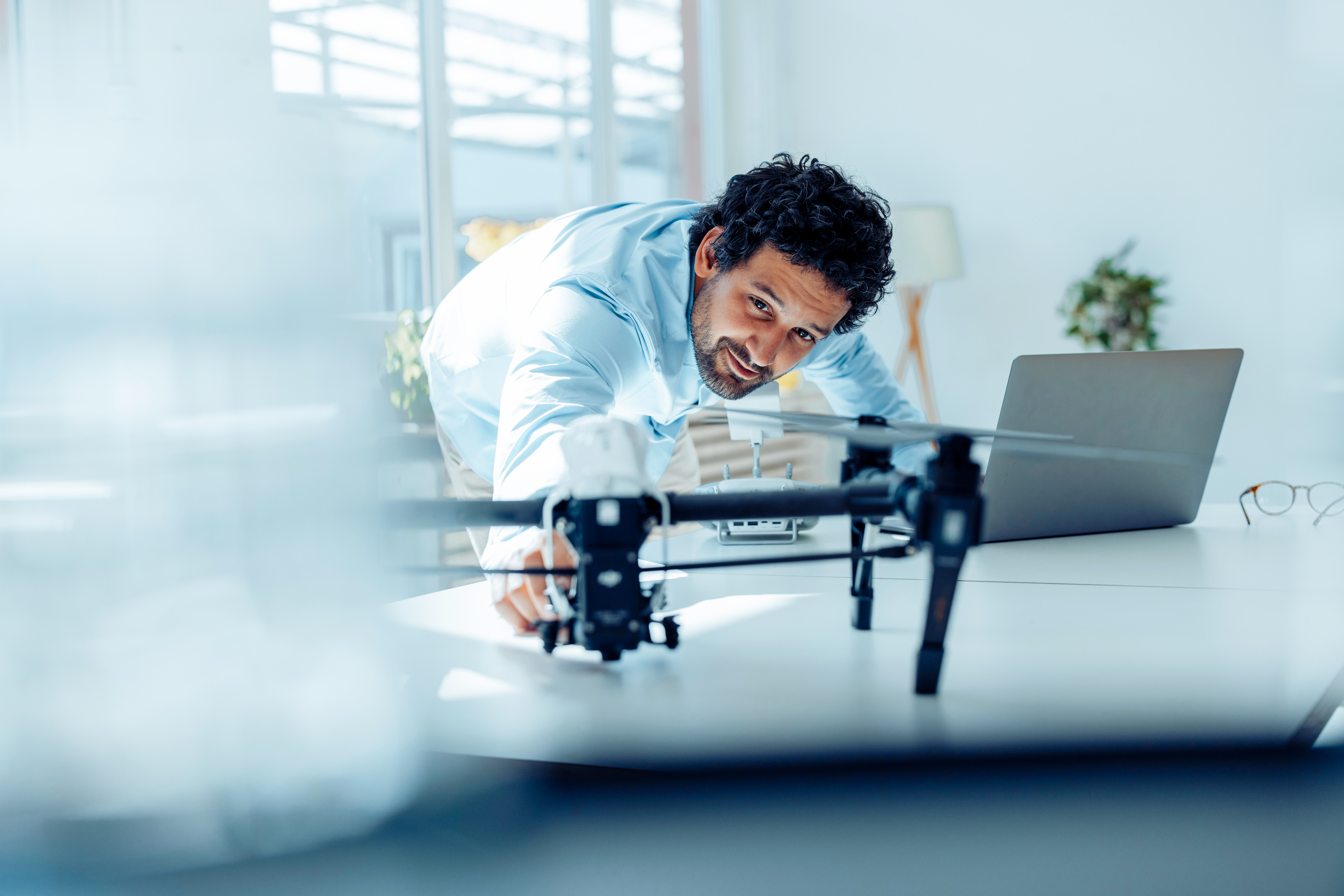
The number of drones is growing rapidly worldwide. At the same time, these systems are becoming smaller, faster, more autonomous, and more versatile. (photo: AdobeStock)

Stephan Kienzle, Associated Partner at MHP. (photo: MHP)

Mirko Geyer, Spokesperson AI, Cyber Security, Aerospace & Defense. (photo: MHP)



Mirko Geyer
Sprecher KI, Cybersicherheit, Luft- und Raumfahrt & Verteidigung
MHP Newsroom
Sie benötigen Informationen zu MHP oder zu unseren Leistungen und Kompetenzen? Gerne unterstützen wir Sie mit aktuellen Informationen, Hintergrundberichten und Bildern.