
- Newsroom
- Veröffentlicht am:
Escaping the trap: How to repay technical debt – and safeguard innovation capability
We live in a time when technological possibilities are growing faster than companies’ ability to implement them. Investing in a technology today carries the risk that it may already be outdated tomorrow. Time pressure, unclear requirements and insufficient communication add to this challenge – all of which leads to technical debt. The term originally comes from software development, but it can be understood much more broadly: maintaining outdated IT or production systems also creates technical debt. And this debt is increasingly becoming a challenge for established European companies that must compete with young, fast-growing manufacturing companies from around the world.
Technical debt can be actively managed and gradually reduced. However, high levels of effort required to maintain and retrofit existing systems can also tie up resources that are actually needed for innovation – for example, when companies want to invest in new digital and software-driven manufacturing solutions. The Industry 4.0 Barometer 2026 shows that technical debt has a noticeable impact on such investments: overall, 33 percent of respondents say that the burden of technical debt severely restricts their investment capacity. A further 42 percent report a “moderate” restriction, while only 25 percent are barely affected.
These findings show that technical debt represents a relevant obstacle for the majority, delaying or limiting strategic investments in modern manufacturing technology.
The situation becomes particularly problematic when a company wants to introduce comprehensive new technologies with the aim of achieving software-defined manufacturing. This requires clear prioritization, new governance models and an investment logic that understands software as a strategic value driver. Technical debt and legacy systems, however, tie up budgets and block future investments.
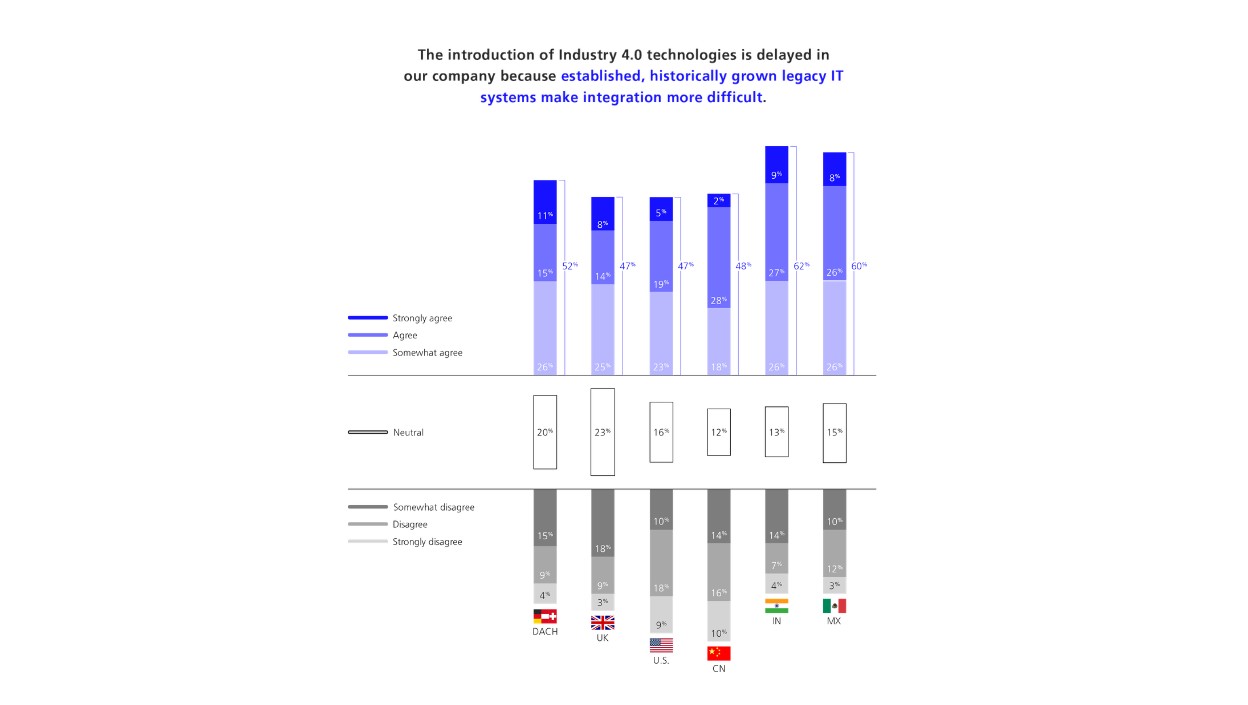
In the DACH region in particular, technological progress is slowed less by a lack of potential than by accumulated technical debt. Here, heterogeneous legacy systems, fragmented data landscapes, limited interoperability and infrastructure constraints such as network quality and IT/OT integration make rapid implementation more difficult and increase the cost of adopting new technologies. This is described in an analysis in the Industry 4.0 Barometer.
Our appeal: strengthen the company’s ability to innovate and prevent legacy IT burdens from accumulating exponentially. Reducing technical debt lowers costs in the long term and minimizes errors. What is the most effective way to proceed? Companies need to gain an overview of their technical debt, prioritize and plan – in other words, assess both business value and technical urgency. Refactoring legacy systems can be highly automated with the help of AI, and this represents a major lever for the future.
The following aspects can help companies effectively address technical debt:
• Measurability and transparency:
Technical debt should be presented in terms of its real causal relationships and not treated across the board as a depreciation item. To create the necessary transparency, tools such as automated code analyses, architecture reviews and health checks should be used regularly.
• Change management and culture:
Dealing with technical debt is not only a technical issue, but also a cultural one. An open communication culture is needed to make all stakeholders aware of the risks associated with outdated systems.
• Business-IT alignment:
The business side often does not see the added value of refactoring if the same functionality is merely delivered using newer, more cost-effective technology. The additional value should be closely aligned between business and IT.
• Automation and DevOps:
The use of DevOps practices, CI/CD pipelines and automated testing can help prevent technical debt from arising in the first place or reduce it continuously. This could be added as a best practice to make ongoing technological change more manageable.
• Use of AI:
AI agents can help understand old code and derive specifications from it. Using approaches such as spec-driven development, largely automated refactoring can be achieved.
• Regulatory and security aspects:
Especially in industrial environments, technical debt can also entail compliance and security risks. The resulting risks often make it possible to quickly derive a business case for refactoring – ultimately, this is an entrepreneurial decision.
• Success stories and quick wins:
A brief reference to best practices or quick wins, such as the targeted modernization of individual core systems or interfaces, can encourage action and show that even small steps can have a major impact.





Rebecca Vlassakidis
Sprecherin Digitale Fabrik, Logistik & Customer Experience
MHP Newsroom
Sie benötigen Informationen zu MHP oder zu unseren Leistungen und Kompetenzen? Gerne unterstützen wir Sie mit aktuellen Informationen, Hintergrundberichten und Bildern.